
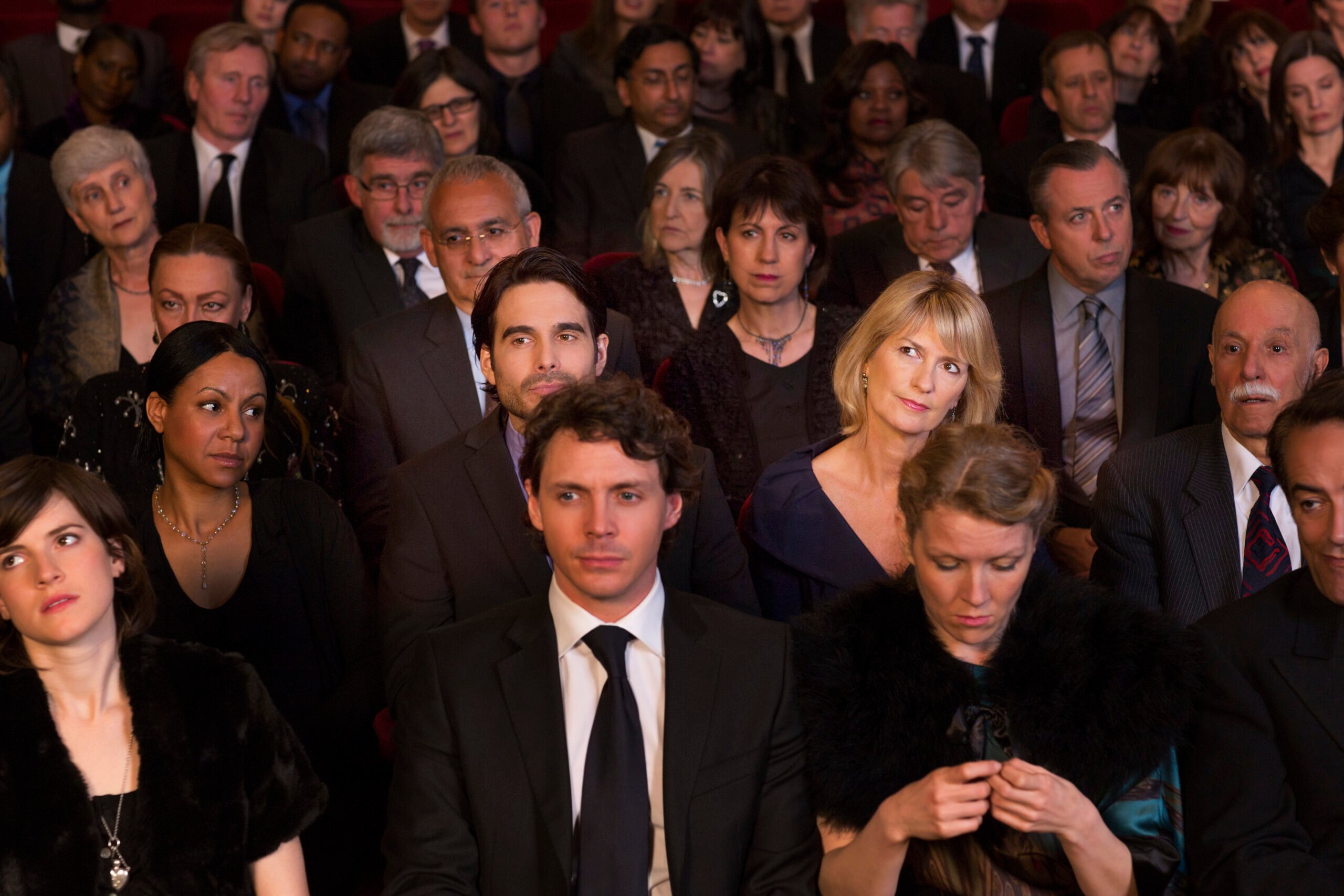
Here’s what actor Matt Damon said during the recent press tour for The Rip, a film directed by Joe Carnahan and co-starring Ben Affleck that debuted on Netflix in January:
“The standard way to make an action movie that we learned was, you usually have three set pieces. One in the first act, one in the second, one in the third. You spend most of your money on that one in the third act. That’s your finale. And now they’re like, ‘Can we get a big one in the first five minutes? We want people to stay. And it wouldn’t be terrible if you reiterated the plot three or four times in the dialogue because people are on their phones while they’re watching.’”
Matt Damon, quoted in Variety
The world’s largest entertainment platform is actively lessening the quality of its projects in order to placate viewers who aren’t really watching them.
Perhaps I should say Netflix is “optimizing its movies” to better accommodate its audience’s needs? No, sorry. I can’t say that. Closed captions are a necessary and useful accommodation. This is something else entirely.
I think a lot about storytelling and visual communication. I’ve written comic scripts and screenplays. I also write video scripts for Rare Bird and some of our clients, and every week, I collaborate with at least one designer on a company’s website, brochure, or downloadable asset, all of which are at their best when the words and visuals work in concert to achieve a common goal.
From a storyteller’s perspective, this stance from Netflix is an obviously bad choice, but it also makes me wonder what we—writers, communicators of any kind—can learn from such a spectacular failure of creative nerve.
Damon specifically called out movie scenes where the onscreen action already conveys what’s happening, but characters verbally explain it anyway, such as a car chase where someone says “They’re getting away!” or an explosion preceded by someone shouting “Look out!”
Such redundancies insult both the creative team and the audience, whether you’re making action movies or trifold brochures.
Trust Your Medium (or Admit You’re Not Really Using It)
Cinema is a visual medium. When you add redundant verbal explanations to visual information, you’re not helping your audience. But you are announcing that you don’t trust the visual storytelling to work.
When words combine with images, you can’t separate what you’re saying from how you’re saying it. By asking filmmakers to say things twice (or 3-4 times), Netflix execs have accepted that audiences being distracted is a concept that’s here to stay. Instead of making content compelling enough to command attention—and make people put down their phones—they’ve merely surrendered.
If you don’t trust the visuals enough to carry the story, why are you producing a product within a visual medium? Why not just make a podcast or (gasp) write a book?
Why Amplify Your Audience’s Worst Behaviors?
I don’t know exactly how Netflix came up with this “solution,” but I suspect it’s based on market research (focus groups, surveys, and the like) and data analytics (when do people stop watching, et al.).
Earlier this year, I participated in a lengthy survey from HBO about the Task series, which my wife and I had just watched and (mostly) loved. I had recently helped Rare Bird orchestrate a major survey for one of our clients, and I was curious to see how my favorite streaming service handled the, um, task.
The survey focused on narrative elements—what I would like to see MORE of or LESS of—if Task were to come back for another season. Some it was pretty specific, actually, about characters, storylines, and thematic concerns.
Because it’s 2026 and we take photos of literally everything now, I snapped a few screenshots.
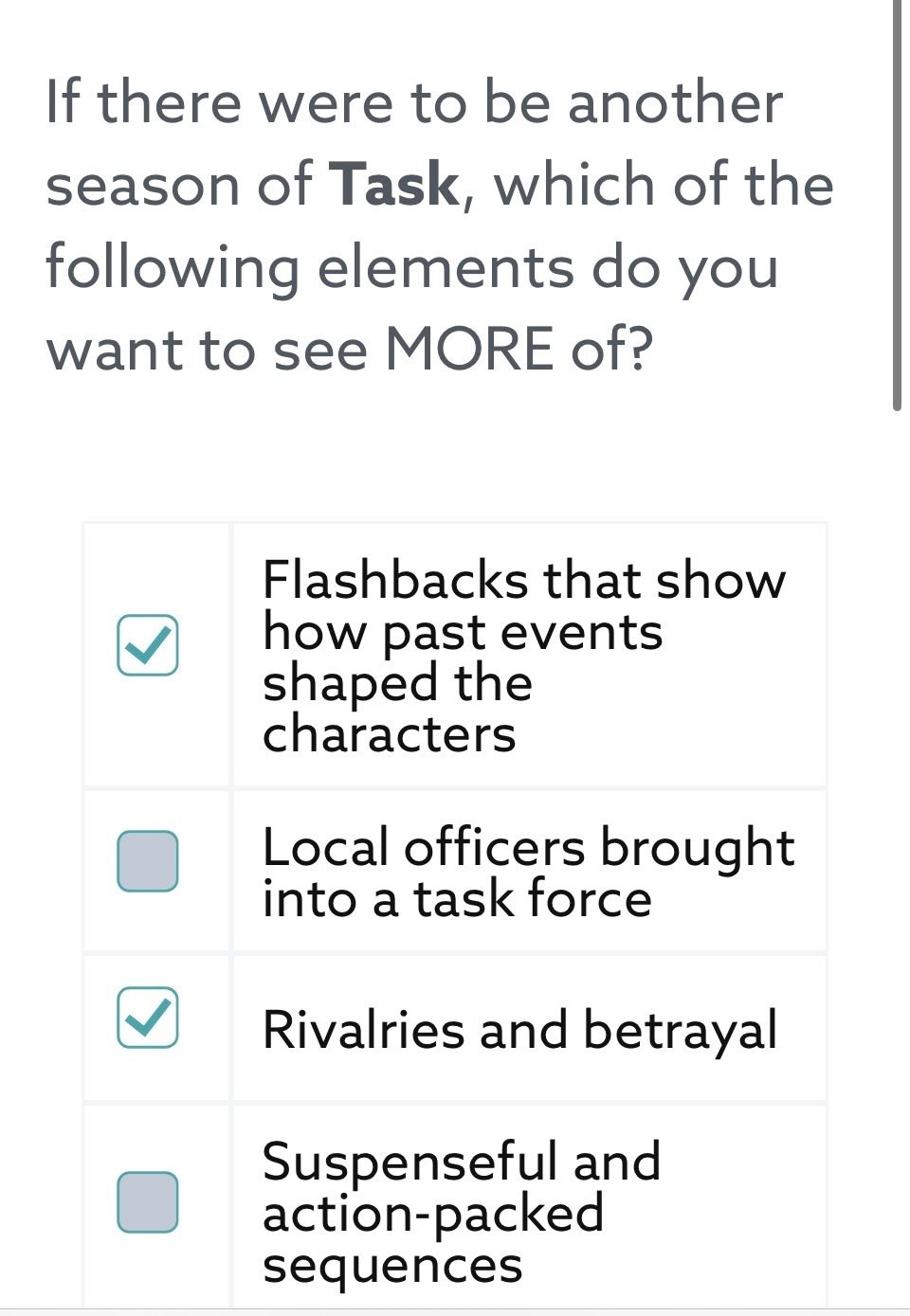
Could it be that survey responses like mine will actually influence what the show’s creators choose to do next season? Perhaps so. But if that’s the case, I am already excluded from the “general population” of those who subscribe to HBO. Not only did I watch the entire series, but I also took the time to complete a survey about it.
In the context of this show, I’m part of an increasingly rare group known as an engaged audience. And basing your next moves on feedback from dedicated, committed, engaged, and (hopefully) articulate customers is almost always a good idea.
But that’s not what Netflix has done.
What Can Companies Can Learn from Netflix?
Whether you’re selling soda, shoes, steel beams, or professional services, you need to know the context around the consumption of your content. Where, when, how, and why does your audience interact with the medium through which you are communicating? That’s something Netflix has done right.
A billboard gets perhaps three seconds of attention at 65 m.p.h. if the driver isn’t busy singing along with the radio. An Instagram story competes with a thumb just itchin’ to swipe, if the story is even seen at all. A sales presentation has a roomful of people checking their phones under the table. Every YouTube video is showcased beside a long column of other videos vying for a click.
Pretending audiences aren’t often distracted may be naïve, but you should ignore the impulse to dumb down your content. If you’re selling industrial equipment, a prospect will choose to read your spec sheet because they need that information. Don’t insult them by adding a cartoon character who says “Wow, these steel beams sure are strong!” when your engineering diagram already lists the load capacity.
If you’re running a shoe ad, trust the image of someone mid-stride on a mountain trail. You don’t need accompanying copy that explains the benefits of that particular running shoe. Leave that for the product description on the website. Aim for copy that sells the ideas, hopes, or dreams associated with the activity depicted in the visual:
- Trails don’t have finish lines.
- Leave the noise behind.
- Find your summit.
Also, it’s worth saying that focused marketing materials aren’t Netflix originals playing in the background while someone folds laundry or gets their teeth cleaned at the dentist’s office. A potential customer found you through a Google search, or followed a colleague’s recommendation, and now they’re on your website. Maybe they even provided their email address so you would send them your free guide.
That’s proof of someone making an active choice to be engaged. Your strategy should be based on the idea that this particular audience actually wants to know more and is focused enough to take relevant action.
Companies that act like their marketing efforts are background noise create background-noise brands. The brands customers remember are the ones that believed their message was worth an audience’s full attention.
A distracted audience is always scrolling, wondering what to make for dinner, or otherwise half-present. But the audiences that fully engage—those who buy comic books every week, rewatch their favorite films 50 times, analyze every minor reference in a Taylor Swift song, and nurture fandoms upon which billion-dollar franchises are built—will always pay attention.
Unfortunately, an engaged (and intelligent) audience is what you lose when you optimize for distraction. Respect both the medium and the audience and you can create something worth a second look.
Put Down the Spoon
Andrew Stanton says that stories work best when audiences assemble meaning themselves. “Don’t give them four,” he says. “Give them two plus two.”
The storyteller chooses which details to include and when to reveal them, letting viewers do the story math on their own, which deepens the engagement and emotional investment in a way that spoon-feeding can never match.
This approach requires precision: pick the right clues, arrange them in the right sequence, and trust people to reach the intended conclusion.
- Applied to character, it means showing behavior instead of explaining it.
- Applied to plot, it means implying events instead of depicting everything.
- Applied to theme, it means letting audiences discover meaning through their own synthesis.
“We’re born problem solvers,” Stanton reminds us in his TED Talk, and a well-told story gives us just enough information that we can’t help filling in the gaps, which creates deeper involvement and momentum. But audiences can’t fill in the gaps if the powers that be demand over-explaining and reiterating every obvious element of your message.
Fix the Storytelling
Before you act on the urge to add a “just to be clear” moment to your messaging, ask yourself: Am I making this clearer to my audience, or am I admitting I don’t trust my own storytelling?
If your visuals, your writing, and your design can’t work together to tell a clear story, you don’t need more explanation. Your core storytelling needs work.
Netflix built the most powerful distribution platform in entertainment history, then used it to make storytelling worse. That’s a remarkable achievement in the wrong direction.
Don’t follow their lead. Whatever you’re making—a film, a website, a brochure, a LinkedIn video, a brand—make it for the audience that’s actually paying attention. They’re the ones who will remember you. (And they’re the one you want to remember you.)
You might also like:
Rare Bird delivers versatile marketing and digital solutions to diverse clientele across nearly every industry. Ready to leverage our expertise to address your business needs?
Let's talk.