
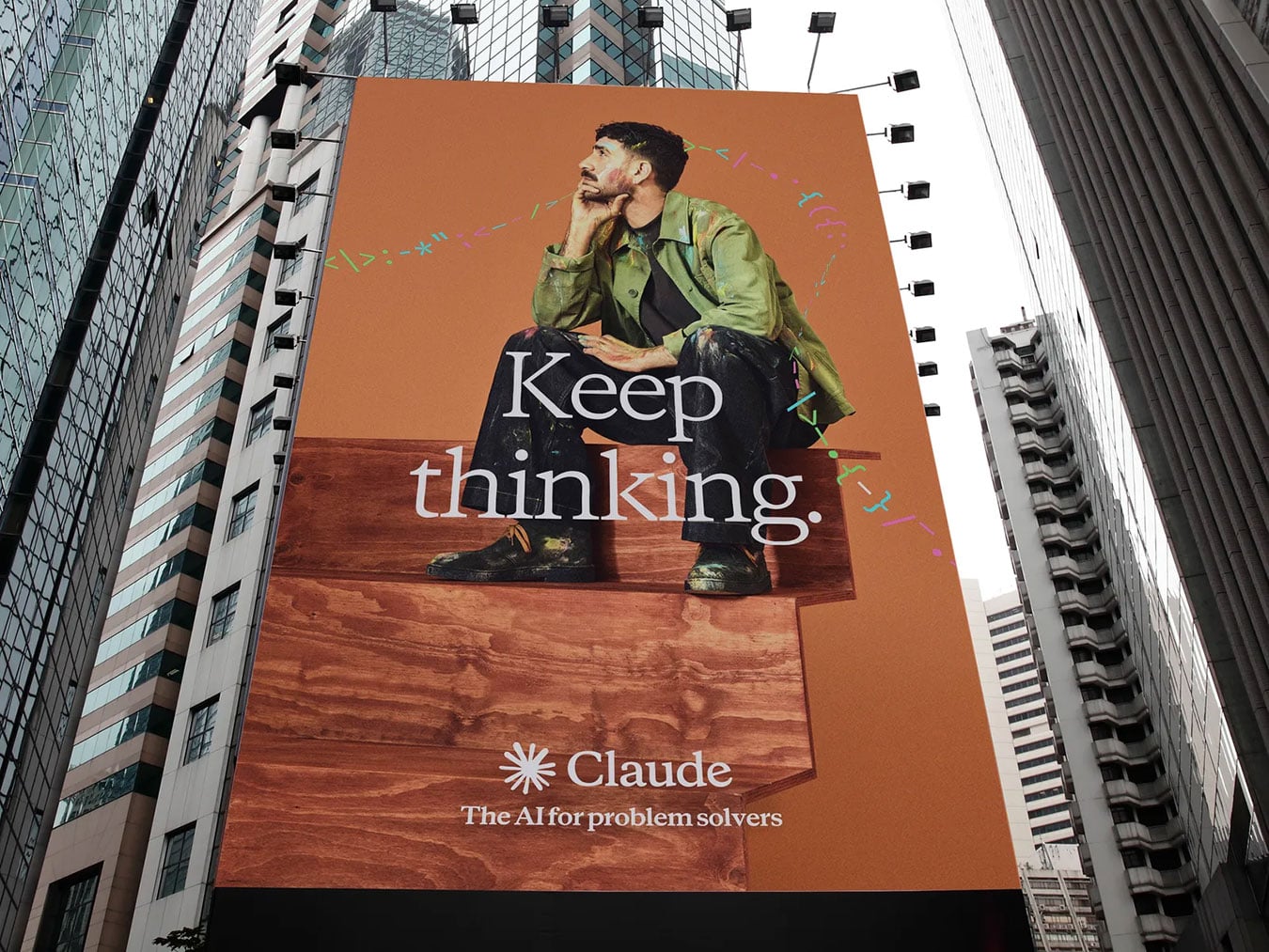
Anthropic, the company behind Claude, understands that trust in its product is essential to marketing it. An AI company that looks careless about its own judgment won’t keep customers for long, and an ad campaign is one of the most public judgment calls a brand can make.
So when Anthropic decided to take Claude to the masses, it hired an agency to help. Mother London wrote and directed the “Keep Thinking” campaign, with several extensions debuting during Super Bowl LX—including a 60-second pregame spot and a 30-second in-game spot—that earned a lot of media coverage.
A second agency, Initiative, handled media buying and decided where the ads should run.
Claude was part of the process of making these commercials, of course, and the agency makes that clear in a way that feels like both its use and the disclosure may have been contractually required. Coverage of the campaign describes Claude synthesizing consumer research, tightening briefs, and helping to wrangle production schedules.
In every account I’ve read, it’s made clear that the concept and the final copy in the TV spots came from people. They want you to know that human discernment, which is the crux of their marketing message (“The AI for problem solvers”), was also at the center of their marketing process.
The problem of not knowing
Over the last year or two, we’ve met with many prospects who lean on AI assistance for some aspect of their marketing. When they approach us, it’s usually because they know something isn’t working. They may not know what the problem is, but they recognize that something isn’t right.
Here are a few problems we’ve identified in these types of conversations:
- If nobody on your team writes, designs, or codes for a living, nobody will know enough to realize when Claude gets something wrong.
- If nobody on your team handles your SEO, nobody will see that the blog post Claude wrote in three minutes is built around a phrase no one types into Google these days.
- If nobody on your team manages your paid search, nobody will catch that the ad Claude optimized for clicks—the one that’s spending your money every day—is targeting audiences who don’t want what you’re selling.
- If nobody on your team understands accessibility, nobody will recognize that your website shuts out customers who use screen readers. (You’ll learn when a lawyer’s demand letter arrives.)
- If nobody on your team knows how to read code, nobody will discover that the contact form is routing leads to an inbox no one checks.
- If nobody on your team has marketed within your industry long enough to earn a few scars, nobody will catch the turn of phrase that makes your best customer wince.
A language learning model (LLM) like Claude—or ChatGPT, Copilot, Gemini, and many others, though we’ll focus on Claude here—will (mostly) do what you ask it. It can draft 10,000 words before you finish your morning coffee. It will never ask for a deadline extension, and you’ll never be annoyed by the sound of its chewing at the desk next to yours.
Claude is great at generating a response to a prompt, but do you know what to include in the prompt to solicit the most useful response?
Do you know how to judge what Claude has generated for you?

Obvious mistakes aren’t usually the problem
Companies usually catch the most obvious errors made by LLMs. Anyone can spot when a product name is misspelled, or when a website produced by Claude isn’t loading properly. Some of an LLM’s most dangerous mistakes, however, are the statements no one thinks to question. Whether it’s spot-on, only half-right, or completely pulling ideas out of its digital derriere, Claude consistently delivers content in the same calm, capable voice. That means it always seems right, at least at first.
If you notice that something in its reply is off, you’re praised for pushing back, and then it tries again.
What if you don’t notice that anything is amiss? Maybe your paid search ads lean on outdated statistics that haven’t been true since the LLM was trained two years ago. Maybe your audience, who is likely savvier than you think, recognizes your AI crutch and is turned off by it.
Then there’s the simple issue of accuracy. If change happens slowly in your industry, maybe it’s safe to depend on what an LLM “writes.” But if you’re in healthcare, finance, tech, or any of the dozens of other industries in which staying informed (and properly regulated) truly matters, you’d do well to fact-check everything your LLM of choice produces.
And don’t ask one LLM to fact-check another—or itself.
Sometimes the “human in the loop” is missing context
Plenty of vibe-coded websites load beautifully on a founder’s laptop, only to appear broken on a customer’s mobile device.
I used to help college students learn how to look within and between the lines of a poem, play, or short story to more completely understand a work of literature. What meaning they eventually discovered in “Sonny’s Blues” or Fences or any Elizabeth Bishop poem that mentions fish, however illuminating, was never as important as the process they embarked on their way to such discoveries.
That kind of experience—fumbling around in the dark, feeling frustrated, then finding the light switch and realizing you’re a few rooms away from where you started—is precisely what makes humanities courses essential.
Knowledge and experience aren’t easily handed over to an LLM. Discernment isn’t based on having a checklist, but a checklist is exactly what Claude and other LLMs employ each and every time they try to figure out how to answer your prompt. It may happen in just a few seconds, but it’s still just going through a checklist.
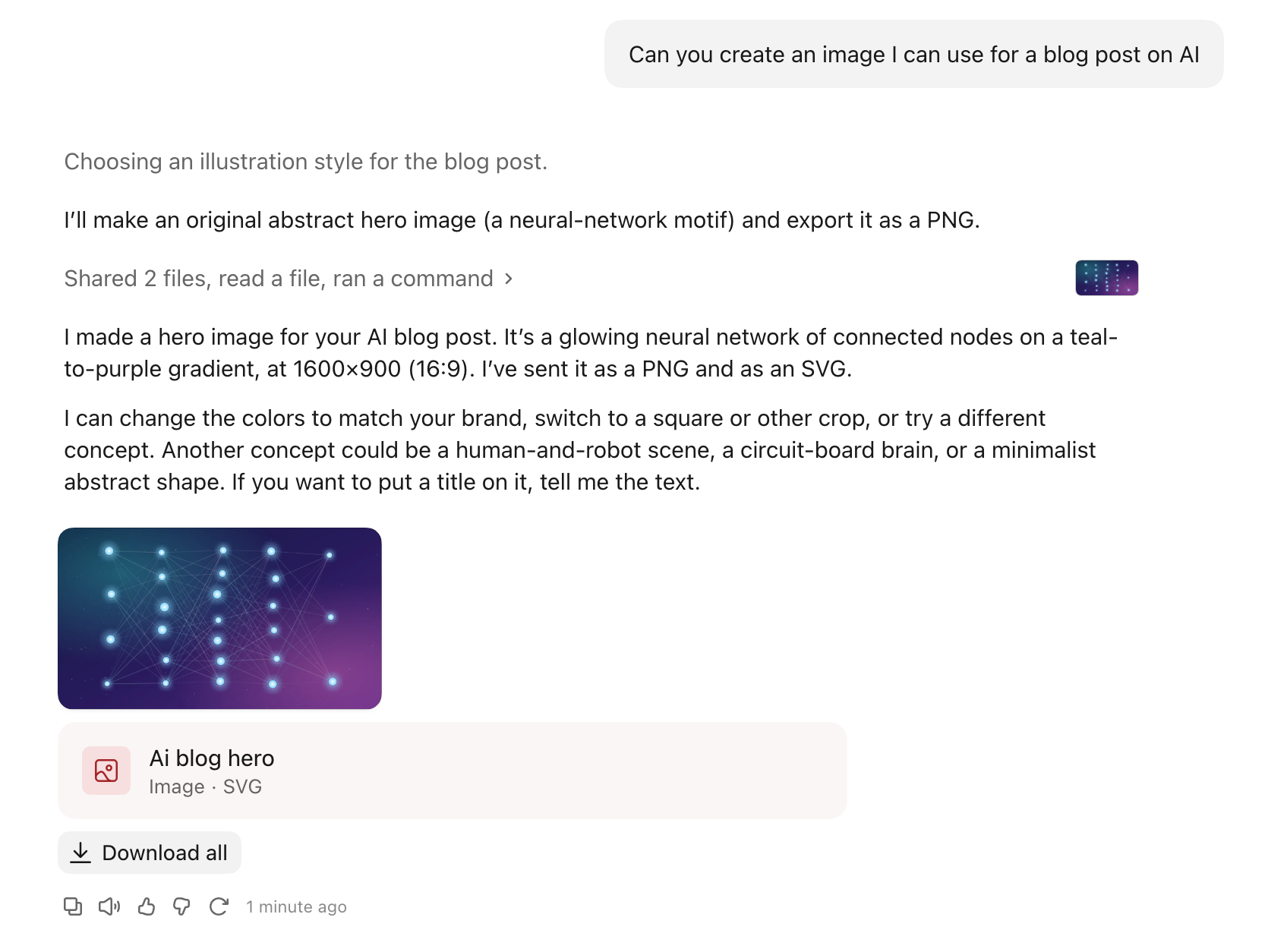
I asked Claude what that is called, when its back-end shows it is deciding how to interpret a question. Such text flashes across the screen only briefly. Here’s its response:
That’s the thinking display, which Anthropic calls extended thinking. Before I write a reply, I reason through the request, and the app shows a condensed view of that reasoning in a collapsible block above the answer. The short line you see, such as “Deciding how to interpret a question,” is a generated summary label for that stretch of reasoning. If you click or expand it, you’ll usually see a longer summary of what I worked through.
That’s the trouble with not knowing what you don’t know. You try to fake it until you make it. And, really, that’s all an LLM is ever doing. It’s trying to give users what they want based on the information it’s been fed—or, in some cases, tries to find—using an operating manual built on specific rules of engagement.
If you’re not especially knowledgeable or experienced in a particular area and place all of your trust in an LLM that just wants to keep you happy, the results can sometimes be disastrous.

The risks of “vibe coding”
When I wrote about business owners vibe coding their own websites. I argued that a company’s website isn’t like a random Tuesday dinner; it’s more like a meal for a special occasion—and one that needs to make a lasting impression. Since then, more requests from people who have built something in Claude Code over a weekend have come our way. They usually ask if we can clean it up or take it across the finish line.
Short answer: We can.
But there are more variables when code is created at the behest of someone who isn’t a full-time developer, even when that person has coded something before. Depending on the details, cleaning up that code can cost more than if we built the site ourselves, if only because the right questions were not asked at the beginning of the project.
If a student came to my office hours a week or two before an essay was due, we would talk through her ideas and she would leave with a plan. The essay submitted before the deadline, while rarely perfect, was never a disaster. Any reader could find evidence of the work and thinking that went into making it.
But other students emailed me a draft an hour before it was due to ask me to pre-grade the essay and tell them what needed fixing before they submitted it. Too often, the truest response was “all of it,” because the right questions had not been asked at the beginning. Or, really, at any stage in the process.
Vibe coding feels like that to me, but with higher stakes. By the time a client hands experienced developers a Claude-built site to “clean up” or “fix,” the LLM has already made hundreds of decisions, including:
- How pages relate to one another. (A visitor who lands on a service page from Google should be able to find their way to a conversation.)
- Where data lives, and who can see it. (Worst case scenario: Customer information ends up somewhere publicly accessible.)
- Which libraries do the work. (Some of them were last updated years ago, and a few have known security holes.)
- What happens when someone submits a form. (Ideally, a lead lands with a salesperson. Sometimes it goes nowhere.)
- Where passwords and API keys are stored. (Occasionally right there in the code, readable by anyone who goes looking.)
- How the site gets hosted and updated. (Every change goes live the moment someone hits save, with no way to roll it back, because a dev site is never part of a vibe-coded website’s plan.)
- What search engines see when they crawl the page. (A site that looks polished to a person can still be mostly invisible to Google.)
- How the team edits content later. (Making a few copy changes shouldn’t require a developer.)
Then there’s the matter of strategy. Because Claude builds what you ask for, it can give you a homepage with a hero image, three service blocks, and a contact form. But did you first consider the different ways your site might rhetorically move a prospect toward a conversation? In a weekend build led by someone who isn’t a full-time developer, such questions are almost never asked.
When we sit down with a prospect, we talk about who the site is for, what a visitor should do next, what the business will need a year from now, and which claims the experts in the audience might check. Our developers know what their code is doing and why. Our writers know which sentences connect, and which sentences sound like “AI slop”—even if AI wasn’t used at all—because we know that suspected AI usage on a website increasingly turns visitors away.
The client still gets what they want—an improved website. The difference is at what stage the discernment arrives. If it doesn’t come until after something is made, the solution is often to start over.
Anthropic had every reason to trust its own tools—to possibly even flaunt its own tools, or show off to a massive audience—and it still chose to bring in the experts.
Doesn’t your business deserves the same care?
You might also like:
Rare Bird delivers versatile marketing and digital solutions to diverse clientele across nearly every industry. Ready to leverage our expertise to address your business needs?
Let's talk.